
By Sol Fallman
The woman I love lives in a house made almost entirely of glass. It sits like a relic of another world, sharp and fragile, reflecting everything but revealing nothing. She has always lived there, as far back as memory stretches, and she has been its center as much as its prisoner.
When we were children, I would walk home from school and see her pressed against the windows, her small hands splayed across the glass. I’d do the same on the other side, our palms separated by a sliver of something neither of us understood. Her light brown hair caught the sunlight as if it were spun from it; her eyes, the same shade, held a warmth that both drew and disarmed me. She would smile, and I’d be sure it could shatter the walls around her.
We would stay like that for minutes, maybe hours, until her father came out, his voice sharp and curt, sending me running. I never questioned why she didn’t leave the house or why he guarded it so fiercely. To my young mind, she seemed happy enough, untroubled by her confinement. The adults whispered about it, but their words were hushed and evasive, like a secret too dangerous to name.
I visited her often, sometimes every day. Over time, her father relented—perhaps worn down by her pleading or her mother’s quiet urgings. He let me in. At first, we played like the children we were: drawing patterns on the fogged glass with our breath, mimicking each other’s movements in a kind of delicate dance. She loved that game; I humored her.
As we grew older, our games gave way to conversation. She would listen as I described the world outside—the turning of the seasons, the strange quirks of the neighbors, the humdrum absurdities of school. She laughed at all the right moments, her giggle like the breaking of waves, and her questions made me feel as though I carried the weight of the universe in my hands.
The glass house became my refuge. Outside, the world was chaotic, ever-shifting. But within those walls, everything was still, constant. Unchanging.
Or so I thought.
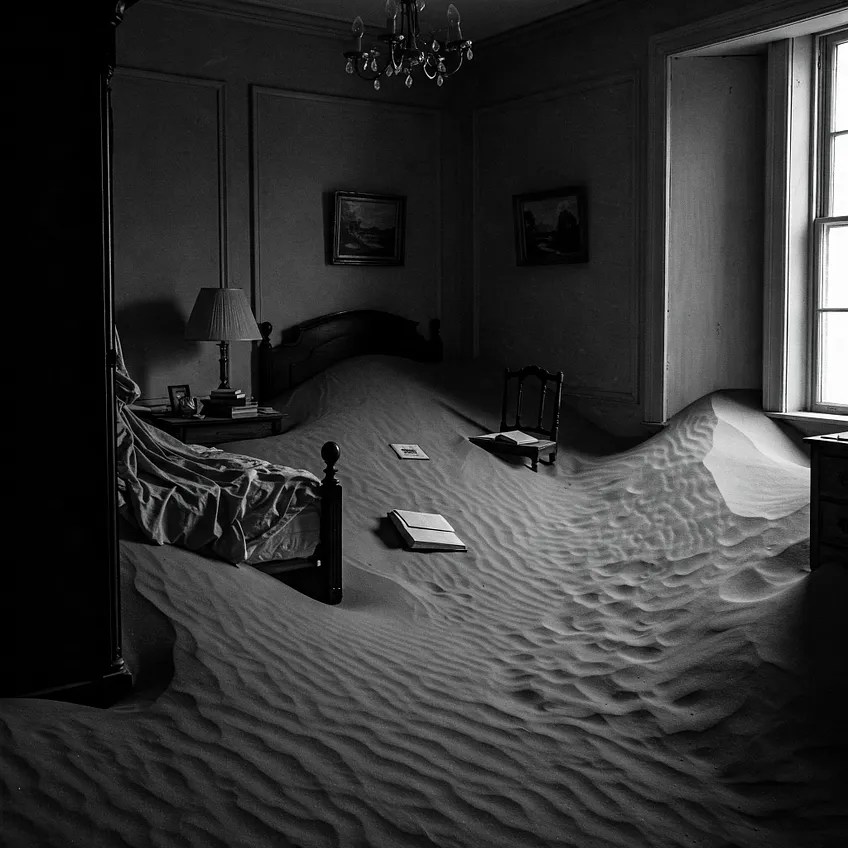
It began as a whisper of change—a sprinkling of sand on the immaculate glass floor. At first, I barely noticed, assuming it was the wind’s doing. But the next time I visited, the sand was still there, and there was more of it. Small piles had begun to gather in the corners, like forgotten secrets.
“Where’s all this sand coming from?” I laughed, gesturing to a growing mound.
She glanced at it, her smile untouched, as though the question were irrelevant. “Oh, it’s nothing. Don’t worry about it.”
Her dismissal nagged at me, but I let it go. We laughed and talked as we always did, yet my eyes kept drifting to the sand. It seemed larger every time, creeping like an unwelcome guest.
When I asked again, she waved it off, her voice light and airy. “It’s just sand.”
But it wasn’t. It was something else, though I didn’t know what. The more I thought about it, the more it consumed me. I began to fixate on it, my questions becoming sharper, my concern harder to mask. She never gave me answers—only that same serene smile, as though the sand were as natural as the sunlight that poured through the windows.
Our time together grew strained. The sand was a wedge, driving us apart in ways I couldn’t fully articulate. I couldn’t stop seeing it, and she wouldn’t let me understand it. Frustration curdled into something heavier. I stopped visiting.
At first, I told myself it was for the best. Distance would give me clarity—or so I thought. But the days stretched long and empty, and the world outside her house seemed dull, colorless. I missed her—her laugh, her way of looking at me as though I were the only person alive. Without her, the world felt like sand slipping through my fingers.
One night, I couldn’t bear it anymore. Under a sky heavy with stars, I ran to her house.
When I arrived, I banged on the door, shouting her name. The sound was muffled, as though the house itself had thickened, rejecting me. No one answered. Desperation took hold. I pushed the door open, and sand spilled out in a slow, mocking cascade, burying my feet. Inside, the house was unrecognizable. The living room, once pristine, was buried beneath dunes.
I yelled her name until it started sounding strange in my head, my voice breaking. There was no answer. Panic clawed at me, my chest tight with the weight of everything I’d left unsaid. Then, in the silence, faintly, I heard her.
“Upstairs.”
Relief flooded me, though it was short-lived. The stairs were buried, the sand piled high and shifting with each step I took. I ran outside, searching for another way. A tree stood outside. One I used to climb as a child as she watched from inside. She would jump up and down, clapping with each branch grasped, and gasped with every slip of my feet. As if she was watching the most riveting show ever produced. I scrambled up its branches, hoisting myself to her window. I could not tell if the ease in which I climbed was due to now being an adult, or if terror trivialized the endeavor.
She was there, waiting, her face calm, her smile unchanged. She didn’t move to help as I pushed the window open and stumbled inside. Her room, too, was filling with sand—a thin layer covering the carpet, rising with an inevitability I couldn’t ignore.
“You’re back,” she said softly.
“I shouldn’t have left,” I replied, breathless. “I’m sorry. Please—let’s leave. Come with me.”
Her expression didn’t change, but her eyes held something deeper—something I couldn’t quite name.
“You don’t have to stay,” she said. “This isn’t your burden.”
“It’s not a burden,” I said. “It’s you. I can’t leave you again.”
She looked out her window, her gaze not fixed on anything. “I can’t leave. This is my fate. But you—you can still go.”
I shook my head. “I won’t.”
The days blurred after that. The sand continued to rise, unrelenting. I tried everything—shoveling, opening windows, even pleading with it. Nothing worked. The sand ignored my efforts, as if an invisible wall kept it from spilling out the open window. Creeping higher and higher, indifferent to my desperation.
“You can’t get rid of it,” she said one day, the sand nearly at our shoulders. “It’s always been this way. You just never noticed.”
Her resignation terrified me. “I’ll fix this,” I said, though I had no idea how.
The sand was at our necks when I made my choice. Grabbing a handful, I brought it to my mouth. It was coarse, sharp, suffocating. It tore at my throat, each grain a needle jabbed in anger at my audacity, but I swallowed. Again and again, I forced it down, ignoring the burning in my chest.
“What are you doing?” she asked, her voice in a tone I couldn’t define.
“If the sand is going to take you,” I said, my voice hoarse, “then I’ll take it first.”
Her eyes filled with tears, but her smile broke through, radiant and unguarded. I realized at that moment I’d never seen her cry.
We laughed, then cried more. We held each other as the sand claimed the last of the space around us. I took another mouthful, but she couldn’t see me do it.
 Jupiter
Leave a comment